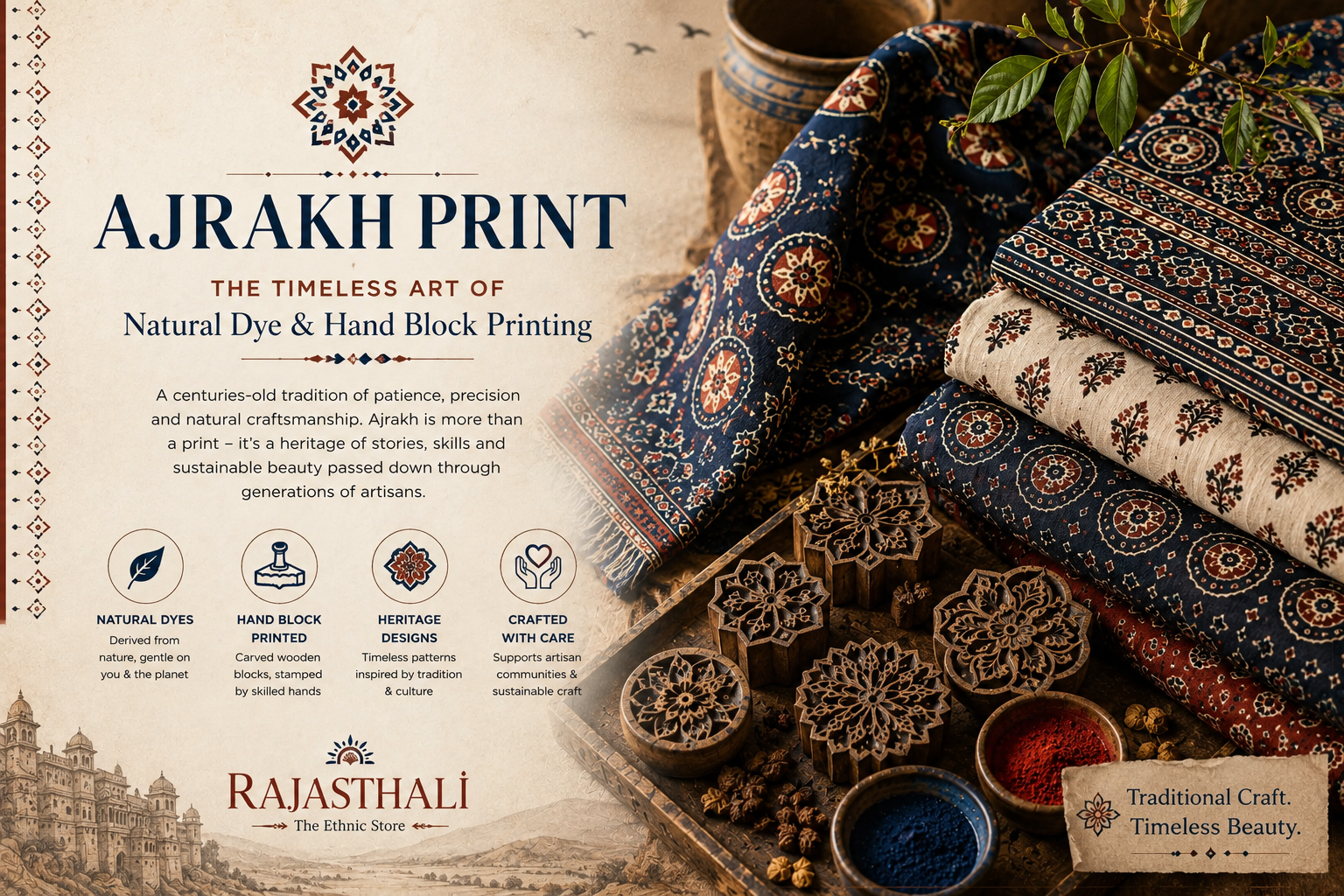
From the deep blues of indigo to the rich reds of madder, Ajrakh print is more than a textile design—it is a centuries-old tradition of patience, precision and natural craftsmanship.
Known for its distinctive geometric patterns, symmetrical motifs and earthy colours, Ajrakh is one of India’s most fascinating hand-block printing traditions. Traditionally associated with Kutch in Gujarat, the craft also has strong connections with Sindh and is practiced in parts of Rajasthan, including Barmer.
At Rajasthali, we celebrate such traditional Indian crafts because every handcrafted textile carries something that machine-made fabric cannot replicate—the touch, skill and story of the artisan.
What is Ajrakh Print?
Ajrakh is a traditional resist-dye and hand block printing technique in which artisans create intricate patterns using specially carved wooden blocks and natural dyes.
Unlike ordinary printing, where colour is simply stamped onto fabric, Ajrakh uses a fascinating process of printing, resisting, dyeing, washing and drying, often repeated several times.
The result is a fabric with remarkable depth of colour and beautifully balanced patterns.
Traditional Ajrakh is particularly recognised for its deep:
- Indigo blue
- Madder red
- Black
- Off-white
- Earthy natural shades
Indigo remains one of the defining colours of the craft.
The Story Behind Ajrakh
Ajrakh’s story is closely connected with the Sindh–Kutch region, where generations of artisan families have preserved the craft.
The Khatri community is particularly associated with Ajrakh printing. Historical accounts describe the craft being brought from Sindh to Kutch, where it developed into the distinctive textile tradition recognised today.
Over generations, artisans refined the techniques of resist printing, natural dyeing and precise block placement.
Today, Ajrakhpur near Bhuj is recognised as an important centre of Ajrakh craftsmanship, while the tradition continues in other regions including parts of Rajasthan.
This journey from Sindh to Kutch and beyond is an important part of Ajrakh’s cultural identity.
Why is Ajrakh So Special?
The beauty of Ajrakh lies not only in its appearance but in how it is made.
A traditional Ajrakh textile can pass through numerous stages of washing, mordanting, resist printing, dyeing and drying. Depending on the artisan and style, the process may involve roughly 14–20 or more stages.
And there is no single shortcut that can replace the experience of the artisan.
Each colour requires careful preparation.
Each block needs accurate placement.
Each dyeing stage changes the character of the fabric.
The final textile is therefore the result of skill, time and patience.
How is Ajrakh Print Made?
1. Preparing the Fabric
The process begins with preparing the fabric so that it can properly absorb natural dyes.
The cloth is washed and treated to remove starch, oils and other impurities. Traditional preparation methods use natural ingredients to soften and prepare the fibres.
This first stage may seem simple, but it is essential for achieving an even and lasting colour.
2. Treating the Fabric with Natural Mordants
The fabric is then treated with substances such as harda (myrobalan) and other natural mordants.
Mordants help natural dyes bond with the fibres and play an important role in creating Ajrakh’s characteristic colours.
This is one of the reasons traditional Ajrakh is such a carefully controlled craft.
3. Carving the Wooden Blocks
Before printing begins, artisans use carefully carved wooden blocks.
Each block represents a specific part of the design.
A complex Ajrakh pattern may require several blocks for:
- Outlines
- Borders
- Floral or geometric motifs
- Red areas
- Resist areas
- Repeated patterns
The blocks must be aligned with remarkable precision.
A tiny error repeated across the fabric can change the entire appearance of the design.
4. Resist Printing
This is where Ajrakh becomes truly distinctive.
Instead of simply applying colour, artisans apply a resist paste to selected areas of the fabric.
The resist prevents dye from penetrating those portions.
Traditional resist materials can include combinations of lime, gum and other natural ingredients.
The artisan then presses the carved wooden block onto the fabric by hand.
Block by block.
Pattern by pattern.
Colour by colour.
5. Natural Dyeing
The fabric is then dyed using natural colours.
One of the most iconic is indigo, which creates Ajrakh’s characteristic deep blue.
Madder and related natural dye materials create rich reds, while iron-based preparations can contribute to black shades. Pomegranate and myrobalan are also associated with the natural-dye palette used in traditional Ajrakh.
After dyeing, the fabric is washed and dried before the next stage.
6. Repeating the Process
This is what makes Ajrakh so labour-intensive.
The artisan may repeat the cycle of:
Printing → Resisting → Dyeing → Washing → Drying
multiple times.
Each stage gradually reveals another part of the final pattern.
The colours don’t simply sit on top of the fabric—they are built into the textile through a carefully controlled sequence of traditional processes.
The Magic of Double-Sided Ajrakh
One of the most remarkable characteristics of traditional Ajrakh is that it can be printed on both sides of the fabric.
The challenge is enormous.
The patterns on both sides need to align with great precision, requiring exceptional control over the wooden blocks and the printing process.
This gives authentic Ajrakh textiles a distinctive richness and depth that makes them immediately special.
The Designs of Ajrakh
Ajrakh is famous for its symmetrical and geometric patterns.
You will often see:
- Repeating grids
- Stars
- Floral forms
- Circular motifs
- Trellis patterns
- Borders
- Central jaal designs
- Symmetrical geometric arrangements
The designs are carefully organised rather than randomly placed.
This balance and repetition give Ajrakh its instantly recognisable character.
What Do the Colours of Ajrakh Represent?
Ajrakh’s traditional palette is deeply connected with nature.
🔵 Indigo Blue
The signature colour of Ajrakh, traditionally produced using natural indigo.
🔴 Madder Red
A rich red created through natural dyeing processes involving madder and related materials.
⚫ Black
Traditionally achieved using iron-based preparations.
⚪ White
Often created through resist techniques, where the fabric remains untouched by a particular dye.
Together, these colours create the dramatic contrast that makes Ajrakh so recognisable.
Ajrakh and Rajasthan
Although Ajrakh is strongly associated with Kutch, Gujarat, the craft also has an important presence in Rajasthan, particularly in the Barmer region. Rajasthan’s own Ajrakh traditions have developed their regional character while remaining connected to the wider Sindh–Kutch textile heritage.
This makes Ajrakh an especially beautiful example of how Indian textile traditions travel across regions while continuing to evolve.
Ajrakh in Modern Fashion
Ajrakh has moved far beyond traditional clothing.
Today, Ajrakh-inspired and traditionally crafted textiles are used for:
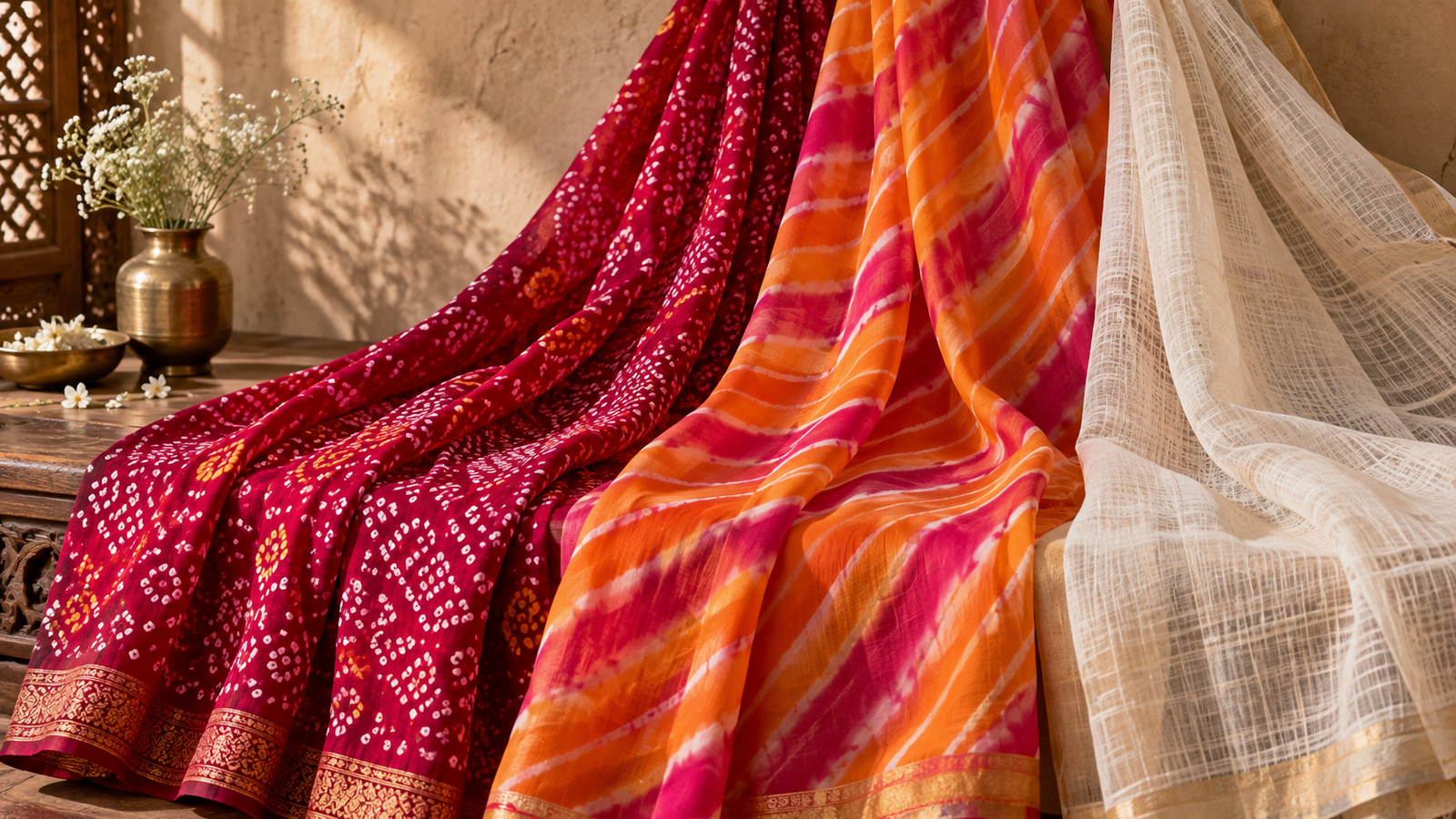
- Sarees
- Dupattas
- Kurtas
- Shirts
- Stoles
- Dresses
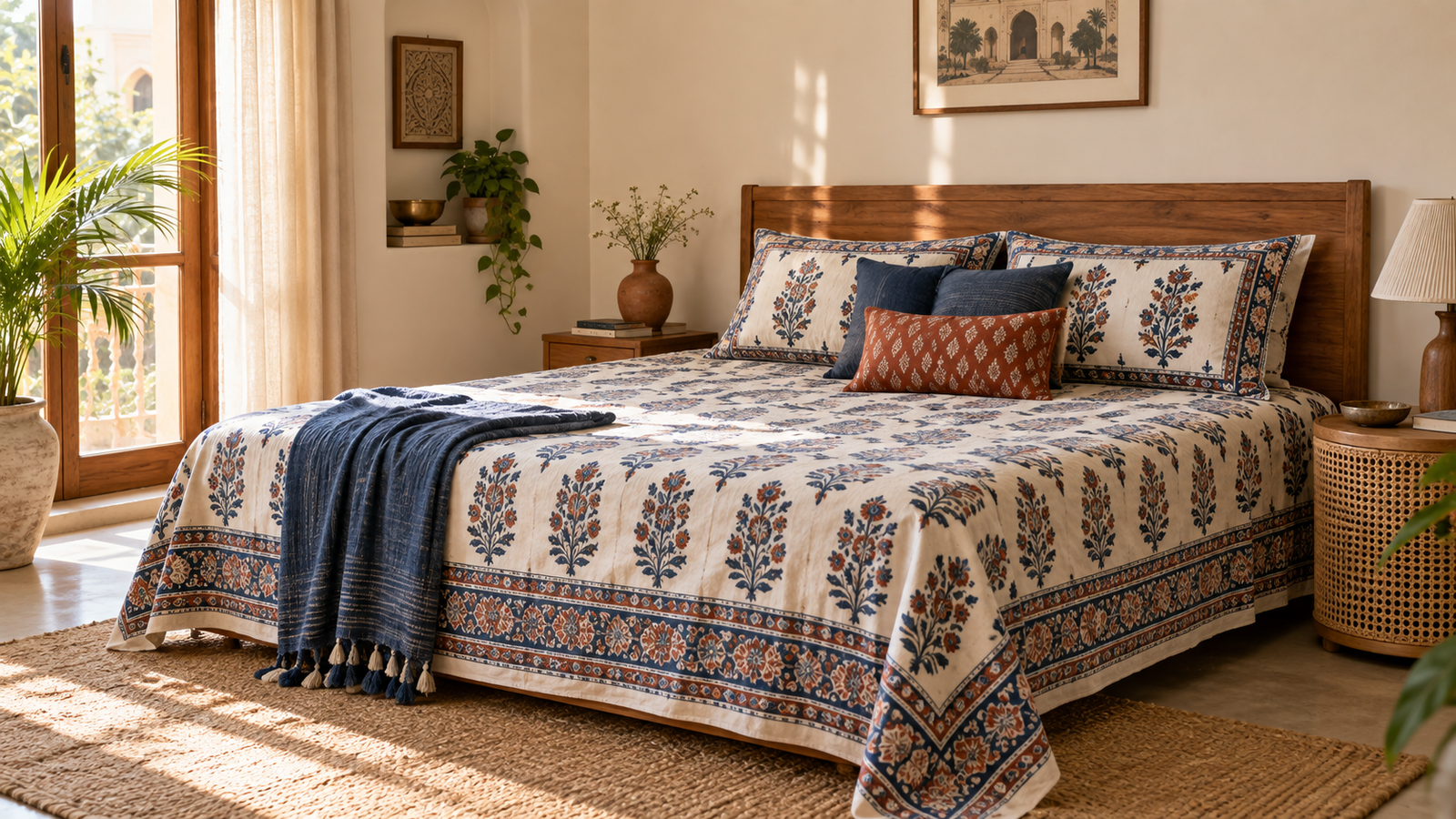
- Bedsheets
- Cushion covers
- Home décor
- Scarves
- Jackets
Its bold geometry and natural colour palette make it equally suitable for traditional and contemporary styles.
A classic Ajrakh saree can look effortlessly elegant, while an Ajrakh shirt or stole can add a handcrafted touch to everyday fashion.
How to Recognise Authentic Hand Block Ajrakh
When buying Ajrakh, look beyond the pattern.
Look for Handcrafted Details
Because the fabric is printed by hand, tiny variations may occur. These subtle imperfections are often part of its handmade character.
Look at the Colour
Traditional natural dyes have a depth and character that can differ from synthetic printed fabrics.
Check the Reverse Side
Traditional Ajrakh is often printed on both sides, with careful alignment between the patterns.
Understand the Process
The most important question is not simply “Does it look like Ajrakh?”
It is:
“Was it actually made using the traditional Ajrakh process?”
Because machine-printed fabrics can reproduce the appearance of Ajrakh without reproducing the craftsmanship behind it.
Why Choose Handcrafted Ajrakh?
Choosing Ajrakh means choosing more than a beautiful print.
It means supporting:
Traditional craftsmanship
Natural dye practices
Artisan communities
Hand-carved wooden blocks
Generations of textile knowledge
Every piece represents hours of careful work.
And because it is handmade, no two pieces need to feel completely identical.
That is precisely what makes handcrafted textiles special.
Ajrakh: Where Tradition Meets Contemporary India
Ajrakh has survived because it continues to adapt.
Its traditional indigo, red, black and white palette still feels timeless, while its geometric patterns work beautifully with modern silhouettes and interiors.
From the workshops of Kutch and Rajasthan to contemporary wardrobes and homes, Ajrakh continues to tell the story of India’s living textile heritage.
It reminds us that handmade does not mean old-fashioned.
It means crafted with intention.
Discover the Beauty of Indian Handcrafted Textiles
At Rajasthali, we believe India’s traditional crafts deserve to be experienced, appreciated and carried forward.
Our collection brings together the beauty of Rajasthan’s rich textile and handicraft traditions, connecting traditional artistry with today’s lifestyle.
Whether you are looking for an elegant Ajrakh saree, a handcrafted stole, a statement kurta or beautiful textiles for your home, every piece carries a story of Indian craftsmanship.
Explore traditional Indian textiles at Rajasthali and bring home a piece of India’s living heritage.
Rajasthali
Dakshinapan Market, Kolkata
Shop Traditional. Support Artisans. Celebrate Indian Craftsmanship.
Leave a comment