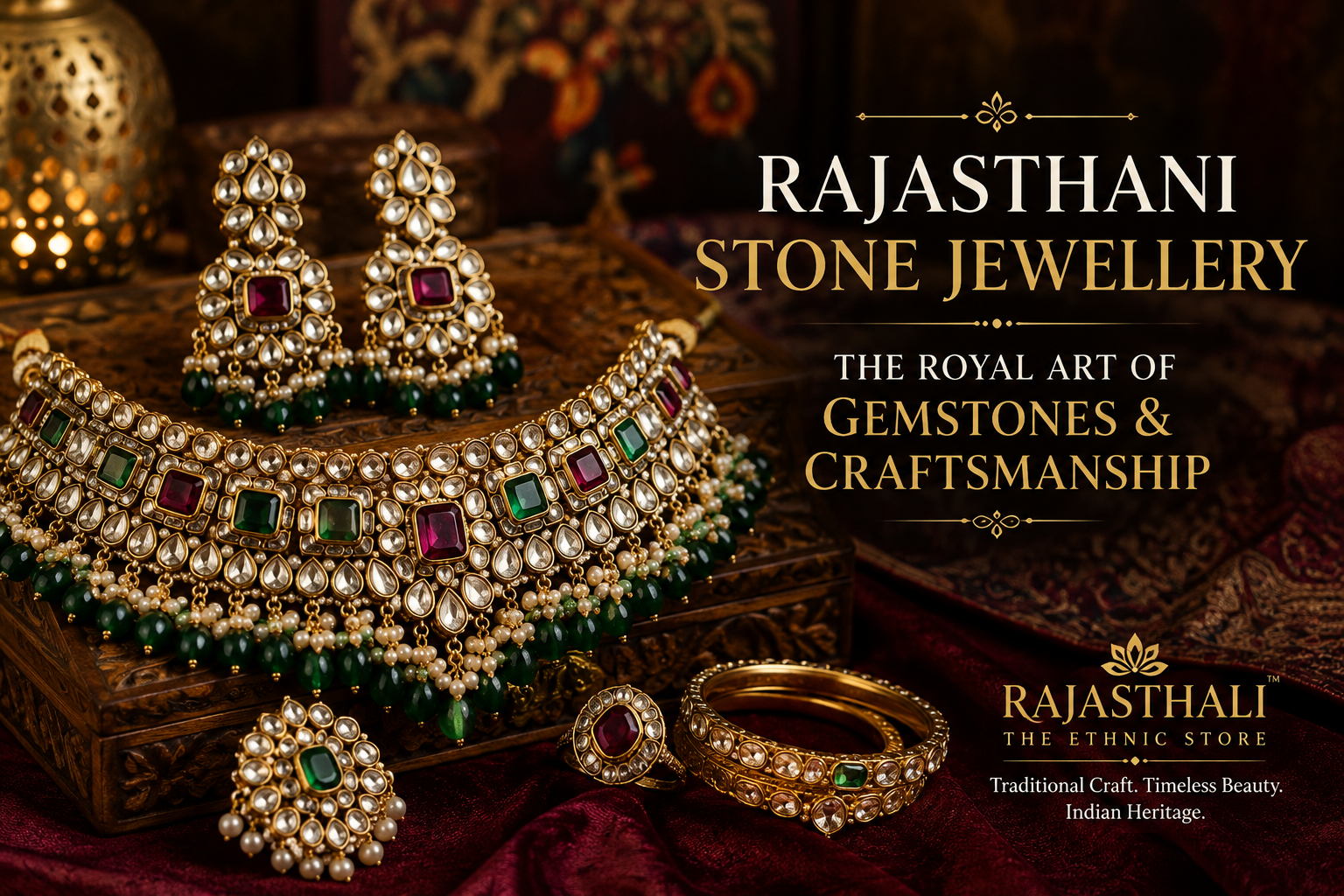
Few things represent the grandeur of Rajasthan quite like its traditional jewellery.
From colourful gemstones and uncut stones to intricate Kundan settings and elaborate Jadau designs, Rajasthani jewellery has been shaped by centuries of royal patronage and skilled craftsmanship.
The jewellery traditions of Rajasthan are particularly famous in cities such as Jaipur, Bikaner and Nathdwara, where different forms of gemstone setting, Kundan and enamel work have developed over generations.
At Rajasthali, we celebrate this artistic heritage by bringing the beauty of traditional Indian jewellery closer to modern wardrobes.
What is Rajasthani Stone Jewellery?
Rajasthani stone jewellery refers to a wide range of traditional jewellery styles that use coloured gemstones, uncut stones, glass stones or other decorative stones within handcrafted metal settings.
Depending on the style, the jewellery may feature:
- Kundan setting
- Jadau craftsmanship
- Polki-style uncut stones
- Colourful gemstones
- Meenakari detailing
- Gold or silver-toned settings
- Traditional floral and royal motifs
The combination of brilliant stones and detailed metalwork gives Rajasthani jewellery its distinctive royal character.
The Royal Heritage of Stone Jewellery in Rajasthan
Rajasthan has a long association with royal jewellery traditions.
The development of Kundan jewellery became particularly important in Rajasthan, where skilled artisans established themselves and Jaipur became one of India’s best-known centres for the craft. The Government of Rajasthan notes Jaipur, Bikaner and Nathdwara among important centres associated with Kundan jewellery.
Jaipur’s jewellery tradition also grew under royal patronage. Jewellery families have been associated with the city for centuries, producing elaborate pieces incorporating gemstones, enamel and traditional setting techniques.
This royal connection is one reason Rajasthani stone jewellery continues to evoke the elegance of palaces, celebrations and traditional Indian attire.
Kundan: The Art of Setting Stones
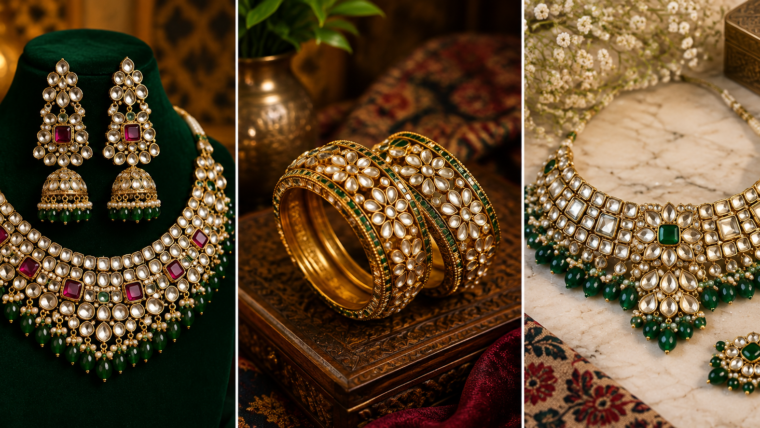
One of the most recognised jewellery traditions associated with Rajasthan is Kundan.
Kundan focuses on carefully setting stones into a prepared metal framework. Traditional Kundan jewellery can incorporate gemstones such as rubies, emeralds and sapphires, along with uncut stones.
The process involves several specialised stages.
An artisan first prepares the framework, followed by the setting of the stones. Traditional techniques can involve lac and highly refined gold used around the stones to secure them.
This multi-stage craftsmanship is what gives traditional Kundan jewellery its distinctive depth and brilliance.
Jadau Jewellery: A Heritage of Detailed Craft
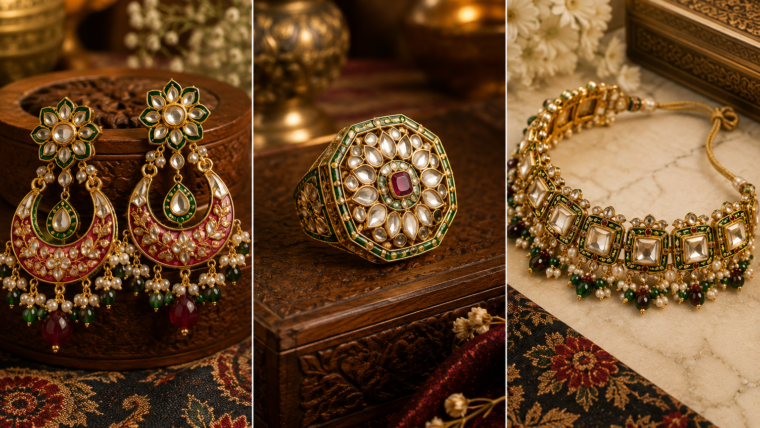
Jadau is another important style connected with the traditional jewellery heritage of Rajasthan.
Jadau jewellery involves setting gemstones into an intricately prepared framework. Traditional Jadia Kundan pieces can include colourful gemstones and elaborate designs associated with royal Rajasthani jewellery.
The process requires the contribution of different skilled artisans, including specialists working on the framework, stone setting, engraving and enamel decoration.
The result is jewellery that feels less like a simple accessory and more like a miniature piece of wearable art.
Polki: The Beauty of Uncut Stones
Polki jewellery is especially admired for its natural and luxurious appearance.
Unlike highly polished faceted gemstones, traditional Polki uses uncut diamonds or diamonds shaped to retain a flatter, natural appearance.
The technique has a strong historical connection with Rajasthan and Bikaner, and Polki continues to be associated with bridal and ceremonial jewellery.
The slightly irregular character of uncut stones gives Polki jewellery its distinctive old-world charm.
It is this imperfect beauty that makes every piece feel unique.
The Colourful World of Gemstones
Colour plays an important role in traditional Rajasthani jewellery.
Different stones can create completely different moods:
❤️ Ruby Red
Red stones bring warmth and a rich royal character to jewellery.
💚 Emerald Green
Green creates a vibrant, elegant appearance and pairs beautifully with gold-toned settings.
💙 Blue Stones
Blue adds depth and sophistication, making it especially striking against traditional Indian outfits.
🤍 White Stones
White stones create a clean, classic appearance and can beautifully balance stronger colours.
💗 Pink & Multicoloured Stones
Colourful combinations give traditional jewellery a festive and contemporary feel.
The use of multiple colours is one of the reasons Rajasthani jewellery can complement such a wide variety of Indian clothing.
Rajasthani Stone Jewellery and Meenakari
Stone jewellery and Meenakari often come together beautifully.
Kundan focuses primarily on the intricate setting of gemstones, while Meenakari introduces colourful enamel decoration to the metalwork.
Traditional Kundan-Meenakari jewellery may therefore feature stones on the front and colourful enamel work on the reverse.
This combination creates jewellery that looks beautiful from different angles.
It is also an excellent example of how multiple traditional crafts can come together in one ornament.
How Rajasthani Stone Jewellery is Made
Creating traditional stone jewellery is a detailed process.
1. Designing the Jewellery
The artisan first develops the shape and decorative pattern.
Traditional designs may include:
- Flowers
- Leaves
- Paisley motifs
- Birds
- Geometric patterns
- Royal-inspired details
2. Preparing the Metal Framework
The base is shaped according to the final jewellery design.
Depending on the style, the framework may be made using gold, silver or other metals.
3. Preparing the Stone Setting
Small spaces are carefully prepared to accommodate the stones.
The artisan must ensure that every stone fits properly within the design.
4. Setting the Stones
The selected gemstones or decorative stones are carefully positioned and secured.
This stage requires considerable precision because the alignment of the stones affects the overall appearance of the finished jewellery.
5. Adding Decorative Details
Depending on the design, the jewellery may receive additional engraving, enamel work or decorative elements.
This is where Kundan, Jadau and Meenakari techniques can complement one another.
6. Finishing & Polishing
The final piece is cleaned and polished so that the metal and stones reveal their full visual brilliance.
The finished jewellery is then ready to become part of a traditional or contemporary look.
Why Handmade Stone Jewellery is Special
The charm of handcrafted jewellery lies in the details.
Unlike completely mass-produced pieces, handmade jewellery can have tiny variations in:
- Stone placement
- Colour
- Engraving
- Surface finish
- Decorative patterns
These subtle differences are part of the character of handmade craftsmanship.
They remind us that the jewellery was created through skilled human hands rather than simply produced by a machine.
Stone Jewellery for Weddings & Festive Wear
Rajasthani stone jewellery naturally complements Indian celebrations.
It can be styled with:
Sarees • Lehengas • Anarkalis • Bandhani • Salwar Suits • Kurtas
A statement necklace can become the centrepiece of a wedding outfit, while traditional earrings or a pendant can add a royal touch to a simpler festive look.
Polki and Kundan styles are particularly associated with bridal and ceremonial jewellery, while contemporary gemstone designs can also be styled for parties and festive occasions.
How to Choose Rajasthani Stone Jewellery
When selecting a piece, look beyond the sparkle.
Look at the Stone Setting
Check whether the stones are positioned neatly and securely.
Examine the Craftsmanship
Fine detailing and clean finishing are signs of careful workmanship.
Check the Colour Combination
Traditional Rajasthani jewellery often combines rich colours with gold or silver-toned surfaces.
Consider Your Outfit
For heavily decorated outfits, a simpler jewellery piece can create balance.
For plain outfits, a colourful statement necklace or pair of earrings can become the highlight.
Appreciate the Handmade Character
Small variations can be part of the charm of handcrafted jewellery.
From Royal Courts to Modern Fashion
Rajasthani stone jewellery has travelled far beyond the royal courts where many traditional styles flourished.
Today, the same inspiration can be seen in:
- Statement necklaces
- Earrings
- Jhumkas
- Rings
- Pendants
- Bangles
- Bridal jewellery
- Festive accessories
The designs may become lighter and more contemporary, but the inspiration remains deeply connected to Rajasthan’s artistic heritage.
Why Jaipur is Famous for Jewellery
Jaipur is one of India’s most important jewellery centres and has a particularly strong association with gemstone jewellery, Kundan and Meenakari.
The city’s jewellery traditions developed alongside royal patronage, and generations of specialist artisans helped establish Jaipur as an important centre for jewellery craftsmanship.
Even today, Jaipur remains closely associated with colourful gemstones, traditional jewellery techniques and elaborate handcrafted designs.
Rajasthani Stone Jewellery: More Than an Ornament
Traditional jewellery is more than something worn for decoration.
It represents:
Royal Heritage
Artisan Skill
Traditional Design
Colour & Creativity
Indian Culture
Every stone, engraving and decorative detail contributes to the story of the craft.
That is what makes traditional Rajasthani jewellery so fascinating—it connects modern fashion with generations of artistic knowledge.
Discover the Beauty of Rajasthani Jewellery at Rajasthali
At Rajasthali, we believe traditional Indian craftsmanship deserves to be appreciated, worn and passed on to future generations.
Our jewellery collection celebrates the colourful artistic traditions of Rajasthan, bringing traditional inspiration into contemporary style.
Whether you are searching for an elegant pair of earrings, a colourful necklace, a statement piece or a special gift, Rajasthani stone jewellery adds a distinctive touch of Indian heritage to every look.
Wear the colours of Rajasthan.
Carry its craftsmanship.
Celebrate its heritage.
RAJASTHALI
The Ethnic Store
Dakshinapan Market, Kolkata
Traditional Craft • Timeless Beauty • Indian Heritage
Leave a comment