
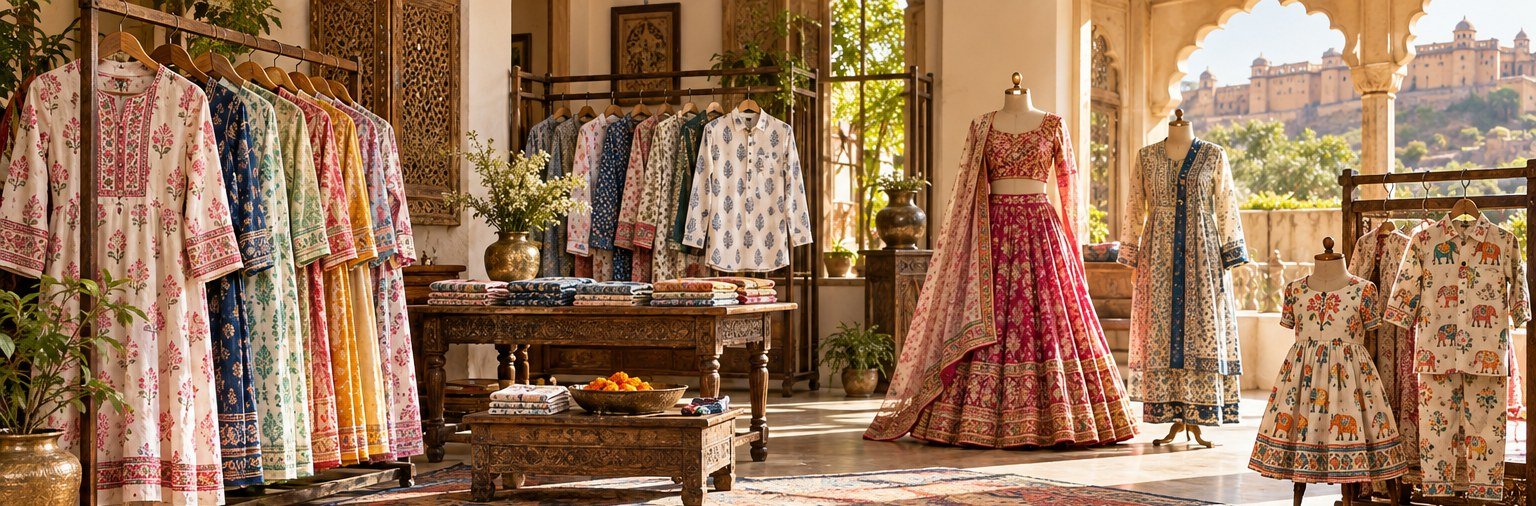
Use print scale, silhouette and colour to choose versatile Jaipuri kurtis, shirts, skirts and coordinated sets.
Start with silhouette
Print attracts attention, but silhouette decides how often a garment is worn. Straight kurtis are easy to layer and pair with trousers; A-line shapes offer movement; short tops and shirts work with denim; printed skirts create a stronger statement. Choose the form for your routine before choosing the motif.
Understand print scale
Small floral butas feel calm and are simple to mix. Medium paisleys and vines become more visible while remaining versatile. Large borders, elephants, peacocks or architectural motifs need thoughtful placement so seams do not interrupt the design. Product photographs should show front, back, neckline and hem whenever possible.

Fit and fabric questions
Size labels vary, so rely on garment measurements. Confirm chest, shoulder, sleeve, waist, hip and length; for children, allow comfortable movement rather than buying only by age. Ask about fabric composition, lining, transparency, pockets, closures and shrinkage. An enquiry-first catalogue should confirm these before payment.
Create more combinations
A limited palette makes printed clothing work harder. Pick two or three solid bottom colours that repeat across several kurtis. Use a Bandhani or Leheriya dupatta with a quieter print, not another equally dense pattern. For men’s shirts, neutral trousers and simple footwear let the block-print direction remain refined.
From cloth length to silhouette
A printed fabric and a finished garment ask different design questions. Once cloth is cut, every seam changes the repeat. A thoughtful maker considers where a border will end, whether a motif will be interrupted at the shoulder and how the print will behave when the garment moves. Straight kurtis preserve a large continuous field; flared dresses open the repeat; shirts break it with collars, plackets and cuffs. Silhouette becomes a form of editing.
Everyday modernity
Jaipur-print clothing is sometimes described only through heritage, yet its strength is also contemporary and practical. A block-inspired shirt with trousers, a short kurti with denim or a printed skirt with a plain knit can belong comfortably to everyday urban life. This is not a dilution of tradition. Useful design has always adapted to the routines, climates and tastes of the people wearing it.
A slower relationship with clothes
Print can encourage more attentive dressing because it makes repetition visible. Instead of chasing an entirely new outfit, one garment can be recombined through colour, layering and accessories. Mending a seam, replacing a button and washing with care extend the relationship further. A wardrobe connected to craft is most meaningful when the clothes are actually worn, remembered and maintained.
A continuing story
Rajasthan’s craft traditions are best understood as living practices rather than a fixed collection of motifs. Makers, wearers and households continually decide what to preserve, what to adapt and how an object belongs in the present. Looking slowly—at material, process, use and change—creates a richer connection than treating culture as surface decoration.


Leave a comment