
Compare block prints, Bandhani, Leheriya, Kota Doria and gota work to find a Rajasthan-inspired saree that fits the occasion.
Begin with the textile story
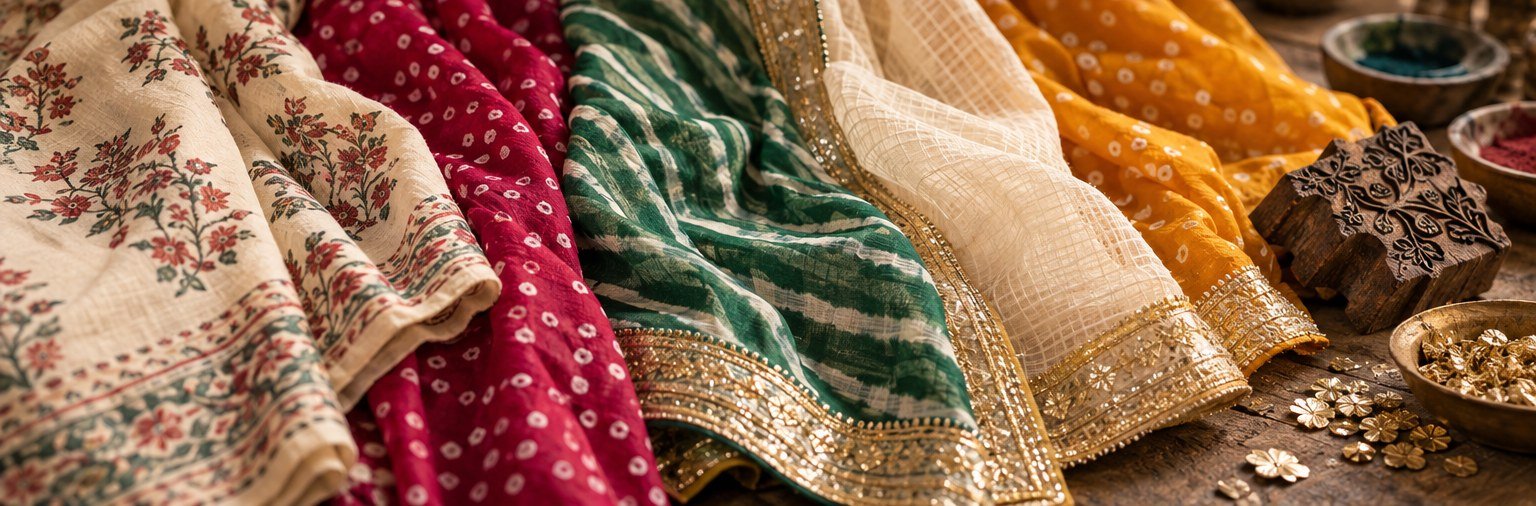
A Rajasthan-inspired saree may express its character through print, resist dye, weave or embellishment. Block florals feel grounded and versatile; Bandhani brings dotted rhythm; Leheriya creates movement; Kota Doria contributes airy texture; gota work introduces celebration and light. Understanding which element leads the design makes choosing much easier.
Match the saree to the occasion
For daytime and frequent wear, consider breathable cotton directions and manageable borders. For a festive gathering, a richer colour, metallic edge or silk-blend direction can feel appropriate without becoming heavy. Chiffon and georgette directions offer fluid drape but require verification of fibre, transparency and embellishment before purchase.
Read the whole composition
Do not judge only by a folded product image. The body, border and pallu should feel related when the saree is opened. Ask to see the full drape, blouse piece, reverse side and close details. Confirm length, width, weight and care. These practical details have more influence on comfort than a colour name alone.
Build a personal styling language
Choose jewellery and blouse details that echo rather than copy the textile. A busy printed saree may need a solid blouse; a quiet Kota-style weave can carry a more decorative blouse or jewellery piece. The most convincing look comes from proportion, comfort and confidence—not from combining every Rajasthan reference at once.
The saree as a complete composition
A saree is experienced in stages. The first wrap establishes the ground, pleats concentrate the pattern, the border draws a line around the body and the pallu becomes a moving panel. A design that looks balanced when folded may behave very differently when draped. Rajasthan-inspired sarees often use this long format to bring several textile languages together—print, resist dye, open weave and reflective trim—without losing the unity of a single cloth.
Drape changes design
The wearer participates in the final composition. Pleat width, pallu length and blouse contrast determine which motifs become prominent. A field of small dots can become almost tonal when pleated; diagonal waves become more dynamic across the pallu; a strong block-printed border can give structure to a soft fabric. There is no single correct visual outcome. The intelligence of the saree lies partly in its ability to be composed anew each time it is worn.
Personal style and inherited language
Traditional references do not prevent personal interpretation. A family blouse, contemporary jacket, simple silver-toned earrings or an unexpected solid colour can shift the mood while respecting the textile. The most memorable styling often comes from knowing when to stop. Allowing one element to lead creates clarity and gives the craft space to be seen rather than burying it beneath a collection of competing symbols.
A continuing story
Rajasthan’s craft traditions are best understood as living practices rather than a fixed collection of motifs. Makers, wearers and households continually decide what to preserve, what to adapt and how an object belongs in the present. Looking slowly—at material, process, use and change—creates a richer connection than treating culture as surface decoration.


Leave a comment